Context Matters: What the Ancient World Reveals About Our Present Crisis
Why history, reason, and the rule of law are failing to protect us from authoritarianism—and what that failure reveals about our moment

“Fortune favors the bold.”
This famous quote, attributed to Pliny the Elder in 79 AD, was repurposed in a Bitcoin advertisement infamously delivered by Matt Damon in 2022. A few months later, the crypto market lost over two trillion dollars, and Bitcoin itself shed roughly 60 percent of its value. It would have been prudent to investigate the context of the original quote.
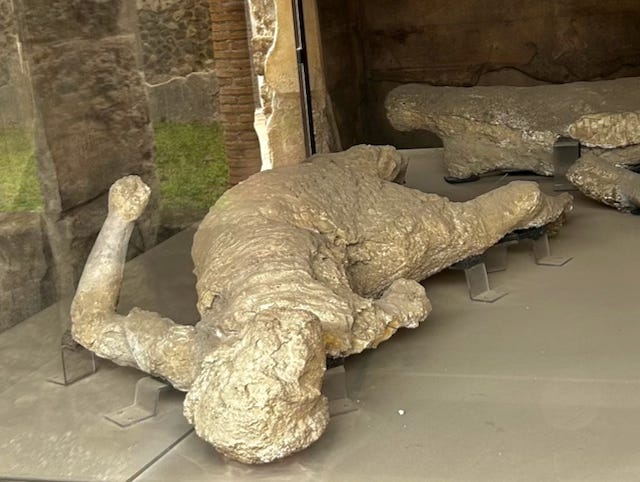
Pliny was aboard a ship, justifying his decision to put both vessel and crew in grave danger in order to evacuate citizens of Pompeii—people who were, quite literally, having a very bad day. Pliny the Elder perished on the docks, overcome by volcanic fumes. Pliny the Younger, perhaps slightly less bold, survived to record the story. What survives with it is a cautionary tale about courage untethered from wisdom.
Context matters.
It matters for our understanding of words, events, and history itself. Historians, political pundits, and commentators—both widely known figures like Heather Cox Richardson and Robert Reich, and relatively unknown writers like me and thousands of others publishing online—are all engaged in the same essential task: furnishing context to help make sense of the world as it unfolds around us.
Without context, the torrent of daily events batters us relentlessly. We are like the souls in Dante’s second circle of Hell in the Inferno, trapped in a violent, eternal storm, tossed endlessly by furious winds. To survive psychologically, we must exercise reason. We must place events in context to shelter our fragile psyches from the ceaseless storm of current events.
The narrative advanced by the MAGA regime is that they are curing the world of the false ideology of liberal democracy and returning the United States to greatness as a white, Christian nation destined to dominate the world. There is an economic dimension that envisions the private sector and wealthy titans of industry freed from the “tyranny” of government regulation; a political and philosophical dimension that calls for shrinking government while concentrating power in a so-called “Unitary Executive”; and, above all, a cultural dimension that seeks to impose an extremist moral code on every citizen.
There are elements of fascism, oligarchy, and kleptocracy in this project, but debating which label fits best is beside the point. From the beginning, the movement has relied on the tools of fascism and is now openly working to replace democracy with authoritarian rule. The script will not replicate the Italian or German versions beat for beat, but it is unmistakably the same story.
Those who accepted this narrative came from a large segment of the population that had witnessed the corruption of politics by powerful interests and wealthy individuals. Neoliberal economic policies over the past fifty years hollowed out domestic manufacturing, pushed it overseas, drove small farmers off the land, and raised the cost of everything from education to health care beyond the reach of middle-class Americans. Life did not improve. The future did not look brighter.
One side of the political spectrum insisted we should stay the course and make minor adjustments. The other side told people exactly what they wanted to hear: It’s not your fault. It’s broken, but we will fix it. In doing so, they exploited ignorance, racism, misogyny, and xenophobia—forces that have always existed in American society, waiting to be weaponized.
Seen in this context, the regime’s innumerable abuses become grimly coherent. Acts of violence against immigrants, Muslims, people of color, women, and LGBTQ people, along with open contempt for the law, make no sense within the framework of a democratic society governed by laws. But they make perfect sense within a fascist framework. Fascism requires only one thing: the willingness of people to obey the leader.
I am sickened, disturbed, and outraged by the actions of this regime—but I am never surprised. I support demonstrations and legal resistance, yet I harbor no illusions that these alone will bring down a fascist government. History tells us that such regimes do not lose power at the ballot box. They manipulate elections or nullify results outright. They do not get voted out. If this one does, it will be an exception.
Understanding our present moment as the rise of a fascist dictatorship does not offer much comfort. We can observe the leader’s cognitive decline and failing health, but even that offers little reassurance. What follows his fall? My limited hope is that the regime’s profound dysfunction and incompetence lead to its collapse and that elections ultimately sweep it away. But even if that happens—what then?
To answer that, we must widen our historical lens. Pliny the Elder is not old enough. We could begin with any civilization, but the Achaemenid Empire, founded by Cyrus the Great, will suffice. Cyrus came to power in 559 BC. His empire was not born of elections. He amassed an army and moved from land to land, offering rulers a choice: submit, pay tribute, supply soldiers—or fight. Those who fought and lost often paid with the slaughter of their men and the enslavement of their women and children.
In this way, Cyrus the Great conquered all of the previous civilized states of the ancient Near East, expanding vastly across most of West Asia and much of Central Asia, creating the largest empire the world had yet seen. He was killed in battle in 530 BC, but his dynasty endured until Alexander the Great swept it aside in 334 BC. Alexander died of sickness while returning home after his troops said, “that’s enough” in India. The Romans eventually absorbed the Greek world and built an even larger empire. The pattern repeated—conquest, collapse, replacement—again and again, with variations, until we arrive at the hazy era we call ‘modernity.’
Between the 16th and 18th centuries societies began constructing rules and institutions based on the belief that progress was possible—that reason, science, and law could tame violence, restrain power, and improve human life. After the devastation of World War II, many believed this experiment was working. By the late 1940s, the assumption was that humanity had learned something enduring.
That assumption is now in doubt.
Modernity rests on reason, science, and the belief that individuals possess inalienable rights. It depends on the rule of law—not perfect justice, but law that binds rulers as well as the ruled. What leaders like Trump have revealed is how fragile these achievements are. Centuries of progress have not made the world immune to tyranny or conquest.
We must resist those who would drag us back to an age where might alone determines right. At the same time, we must build stronger, more resilient institutions capable of restraining aggression and protecting democratic life. Most importantly, we must build societies grounded in human dignity and liberty—societies that genuinely enable people to enjoy life, liberty, and the pursuit of happiness, free from exploitation by a wealthy elite that captures government and manufactures inequality.
Finally, we must confront hatred and prejudice directly by embracing a simple, radical truth: every human being is our brother or sister. We are one human family. If we fail to learn how to live that way, history suggests we will perish in violence—just as so many civilizations before us already have.